I was quite surprised by the number of romantic vignettes in Dan Clowes' Ice Haven, though not surprised at how dysfunctional they all were. Just about every character is faced with some sort of relationship issue: Violet and Charles' parents divorce, Violet marries and subsequently loses Penrod, Charles harbors feelings for his step-sister, Carmichael has a crush on Paula, Mr. and Mrs. Ames are constantly on the outs, Vida and Kim Lee share a brief moment of celebratory lust, Julie "Patheticstein" is pregnant. There are no traditional romantic elements, and I would never categorize Ice Haven as a story about love, but it is definitely one of the more prevalent themes throughout the book.
I found Violet's romantic relationships to be the most interesting in the book. She is a young girl who is clearly very confused about the concept of love (her mother does not seem to be a very good role-model), yet desperately wants Penrod to love her and is willing to do anything to make it happen. However, the only person who cares about her the way she wants is her step-brother, Charles. She cares about him in a different way, and it is perhaps one of the most hearbreaking lines in the book: "I hope someday I grow up and marry a guy just like you" (81.5). Nevertheless, Violet does undergo a major transformation due to her failed marriage to Penrod and, by the end of the book, there is a glimmer of hope that things will be better for her in Hawaii.
Showing posts with label Dan Clowes. Show all posts
Showing posts with label Dan Clowes. Show all posts
Thursday, December 6, 2007

Wednesday, December 5, 2007
A few questions about Ice Haven
Clowes' artwork throughout the book seemed so familiar in some instances that I wondered if some of it wasn't imitation or homage, but I'm not well versed enough in my classic artists that I can pinpoint whom he's aping.
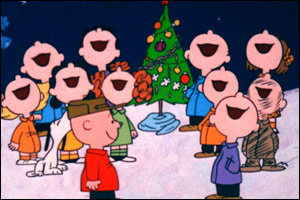
The Charles sections with its focus on a small child's deeply philosophical thoughts reminded me of "Peanuts;" but the artwork not so much so . . . though the images of children singing was evocative of Schultz's singing kiddies for me.
Some of the Mr. and Mrs. Ames sections reminded me of "Spiderman" but maybe that's just because Mr. Ame's hair is so reminiscent of J. Jonah Jameson's
Other than that I can say images felt really familiar but can't put my finger on the possible inspirations. Any help here?
The plot itself in which the residents of a small seemingly isolated town goes about it's trivial business against the backdrop of a major crime, reminded me quite a bit if Gilbert Hernandez's Human Diastrophism in which the residents of Palomar attend to their daily dramas while a serial killer is on the loose in town. Not to mention that strange monolith referred to as "our friend" (8.2) in Ice Haven is an echo of those strange idols that appear throughout the Palomar stories. Not so sure if this is so intentional as the earlier referenced artistic homages.
The Charles sections with its focus on a small child's deeply philosophical thoughts reminded me of "Peanuts;" but the artwork not so much so . . . though the images of children singing was evocative of Schultz's singing kiddies for me.
Some of the Mr. and Mrs. Ames sections reminded me of "Spiderman" but maybe that's just because Mr. Ame's hair is so reminiscent of J. Jonah Jameson's
Other than that I can say images felt really familiar but can't put my finger on the possible inspirations. Any help here?
The plot itself in which the residents of a small seemingly isolated town goes about it's trivial business against the backdrop of a major crime, reminded me quite a bit if Gilbert Hernandez's Human Diastrophism in which the residents of Palomar attend to their daily dramas while a serial killer is on the loose in town. Not to mention that strange monolith referred to as "our friend" (8.2) in Ice Haven is an echo of those strange idols that appear throughout the Palomar stories. Not so sure if this is so intentional as the earlier referenced artistic homages.
Ice Haven: Artistry/Vulgarity
From the panels on page 4, in which comic book critic, Harry neighbors, eloquently addresses the age old of question of what comics are (all the while, urinating, scratching his ass, and eating cereal in his underwear*), I knew Clowes was going to be pulling a few tricks out of his bag for Ice Haven. If there is a mystery at its core, it's not so much "What happened to Danny Goldberg" as it is "what happened to art?" That is to say if it's at all possible to get a handle on what art is. Or to put it in the words of Random Wilder, Ice Haven's self proclaimed future poet laureate "Is there anyone left with the acuity to recognize a genuine artistic sensibility" (9.1) That the reader is not likely to recognize such sensibility in the bombastic Wilder, complicates a reading of his narration as an organizing voice in the larger story of Ice Haven.
Wilder's young neighbor, Vida, is perhaps the only other character in Ice Haven with artistic pretensions and her work finally pushes Wilder to the realization that he is a hack (71-72). In this section of Wilder's story the colors and line have been simplified, reducing Wilder to a more iconic form, a process that appears to have been in motion throughout the book (look at Wilder's legs in "motion" in each of his sections to get the best sense of this). The last section of the book (before Naybor's comes onpage to "explain" everything), is given over to Vida's narration (whereas the first [main] section of the book introduced Wilder as the narrator). Here Vida reveals that she has finally been discovered and is headed to Hollywood to become the "biggest whore ever" (83.4).
Maybe we were better off with Wilder (who in a sense does get the final word as Danny Goldberg recites one of his poems in the book's final frame).
Or maybe the sections of the book that resonate most, don't have anything to do with meta-masturbation. Maybe the heart of the story rests with the human dramas that Wilder would credit to "a public imagination awash in vulgarity" (19.7).
*This sequence is reminiscent of another Clowes' strip depicting an actor playing the author going about his banal morning routines)
Wilder's young neighbor, Vida, is perhaps the only other character in Ice Haven with artistic pretensions and her work finally pushes Wilder to the realization that he is a hack (71-72). In this section of Wilder's story the colors and line have been simplified, reducing Wilder to a more iconic form, a process that appears to have been in motion throughout the book (look at Wilder's legs in "motion" in each of his sections to get the best sense of this). The last section of the book (before Naybor's comes onpage to "explain" everything), is given over to Vida's narration (whereas the first [main] section of the book introduced Wilder as the narrator). Here Vida reveals that she has finally been discovered and is headed to Hollywood to become the "biggest whore ever" (83.4).
Maybe we were better off with Wilder (who in a sense does get the final word as Danny Goldberg recites one of his poems in the book's final frame).
Or maybe the sections of the book that resonate most, don't have anything to do with meta-masturbation. Maybe the heart of the story rests with the human dramas that Wilder would credit to "a public imagination awash in vulgarity" (19.7).
*This sequence is reminiscent of another Clowes' strip depicting an actor playing the author going about his banal morning routines)
Subscribe to:
Posts (Atom)